Make the call before it counts.
Realistic audit scenarios for ISO 27001, ISO 42001, SOC 2, PCI DSS, GDPR, India's DPDP Act and more. Weigh the evidence, pick a verdict, and learn exactly why the right one was right, and why the tempting one wasn't.
Free with Google or LinkedIn sign-in, plus 100 credits for 2 new scenarios on us. Today's scenario and 3 library scenarios a week are on the house.
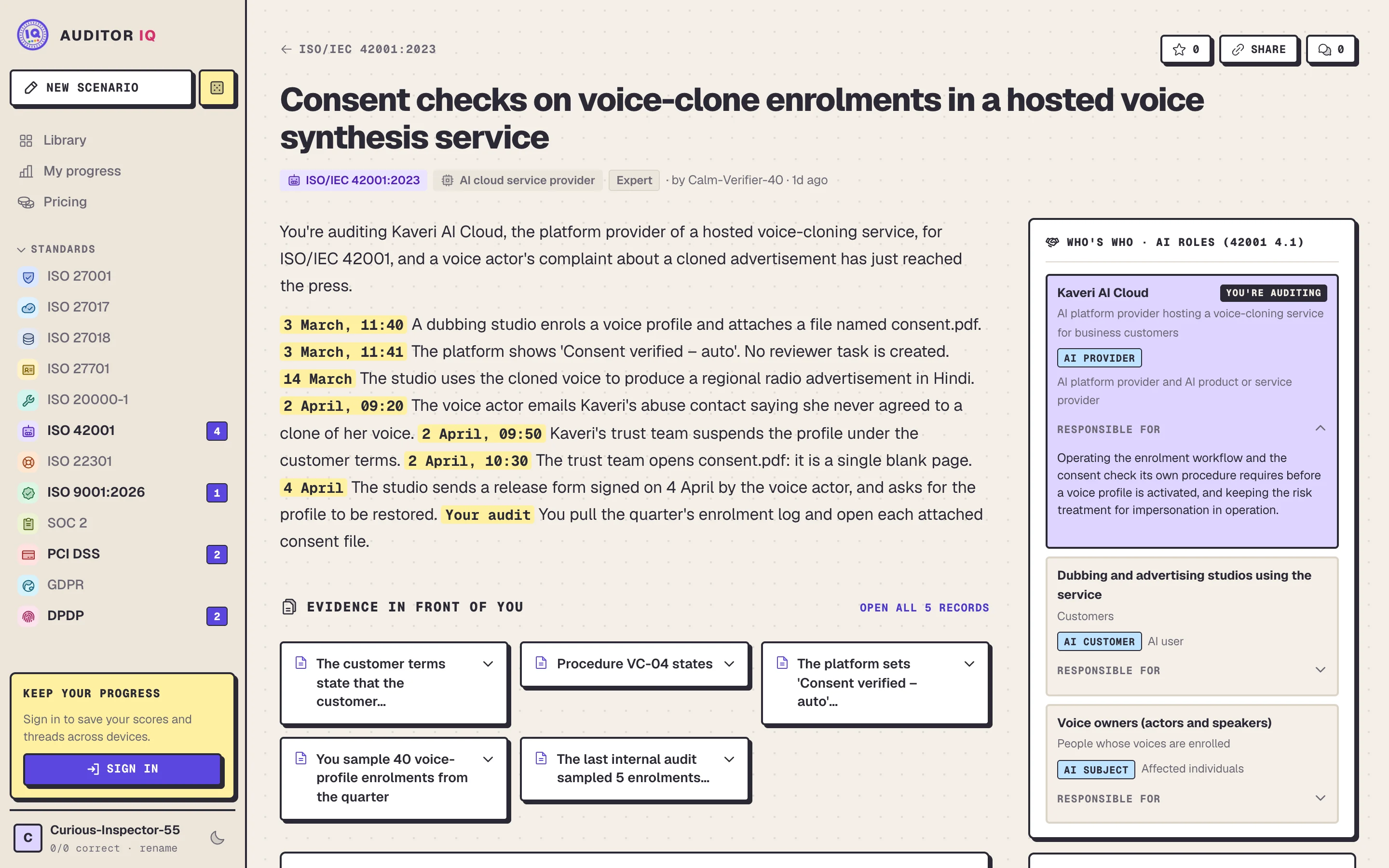
The one-minute tour
From a blank page to a verdict you can defend
Watch one scenario go from pick, to evidence, to hint, to the reveal, and see the dashboard that tracks how your judgement improves.
How it works
Four steps, one judgement call
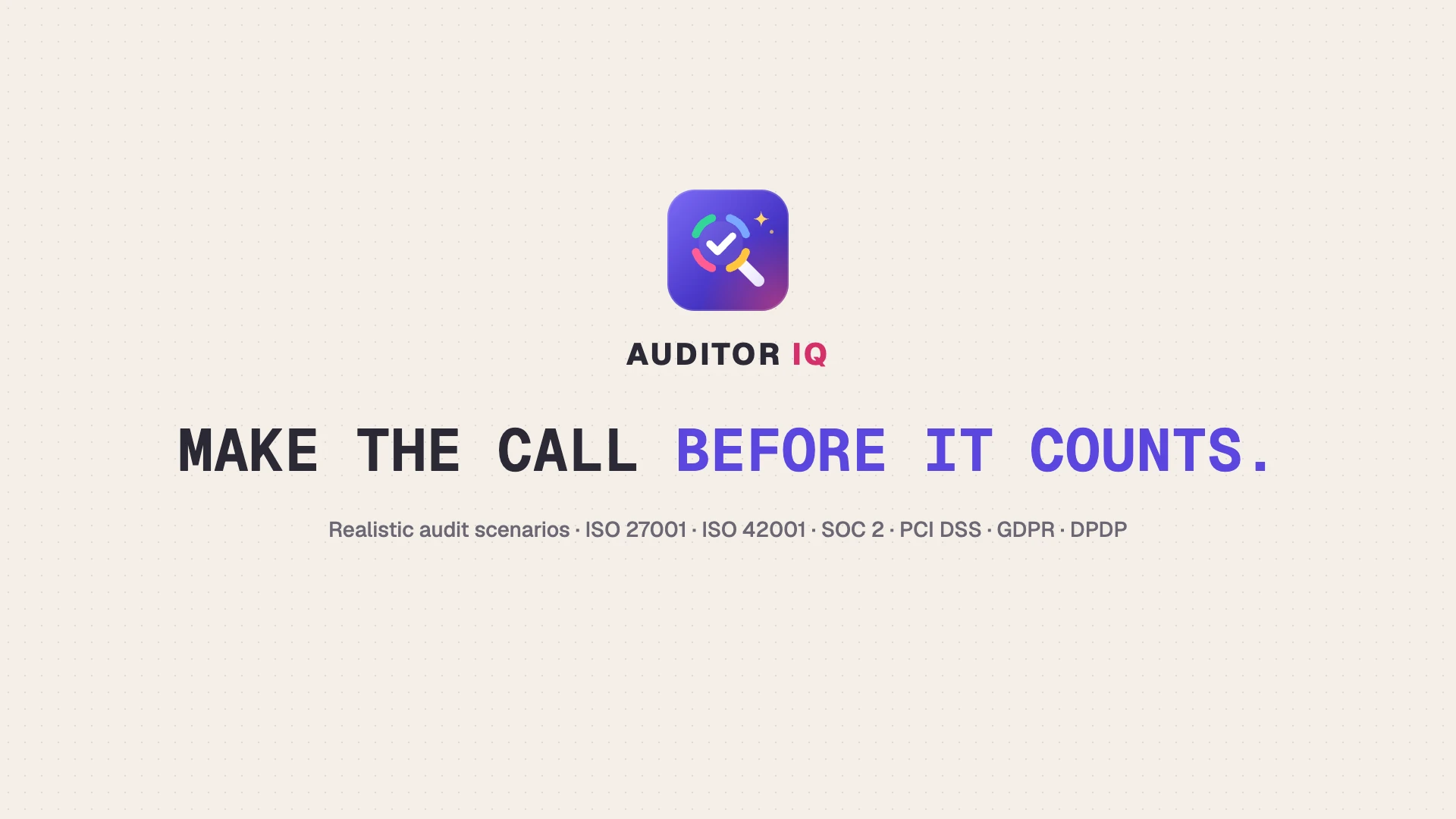
Pick your ground
Choose an industry, a standard and a difficulty, add an optional focus, or roll the dice. Auditor IQ writes a fresh, self-contained audit situation in about a minute.
- 12 frameworks, from ISO 27001 to India's DPDP Act
- Practitioner to lead-auditor difficulty
- Or practise from the shared library: 3 free a week
Read the evidence
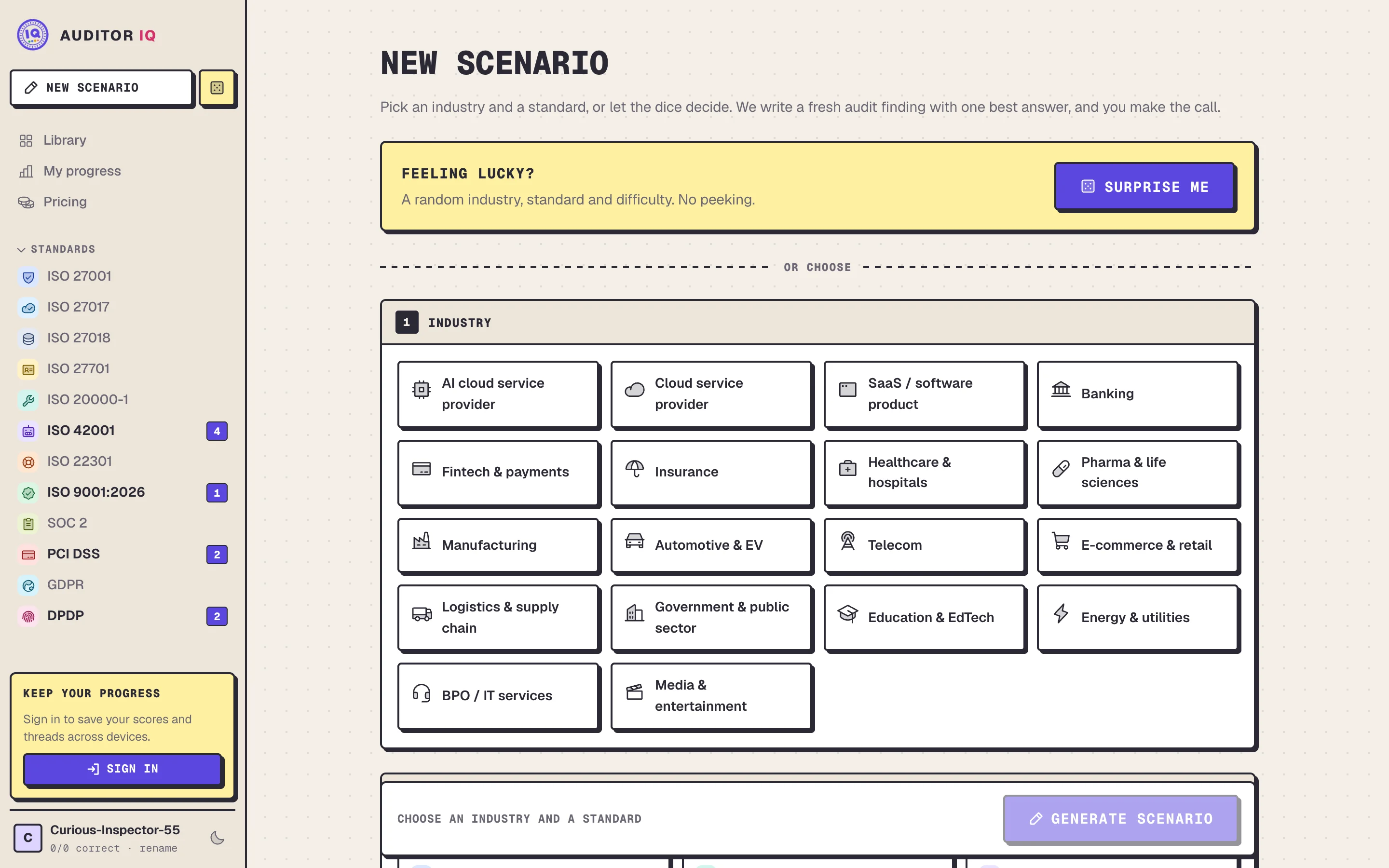
Every scenario reads like a real audit day: a statement with the key times in bold, the records in front of you as cards, and who's who with each party's responsibilities.
- A numeric sample, so you can tell isolated from systemic
- The organisation being audited is clearly marked
- Nothing in the text gives the verdict away
Make the call
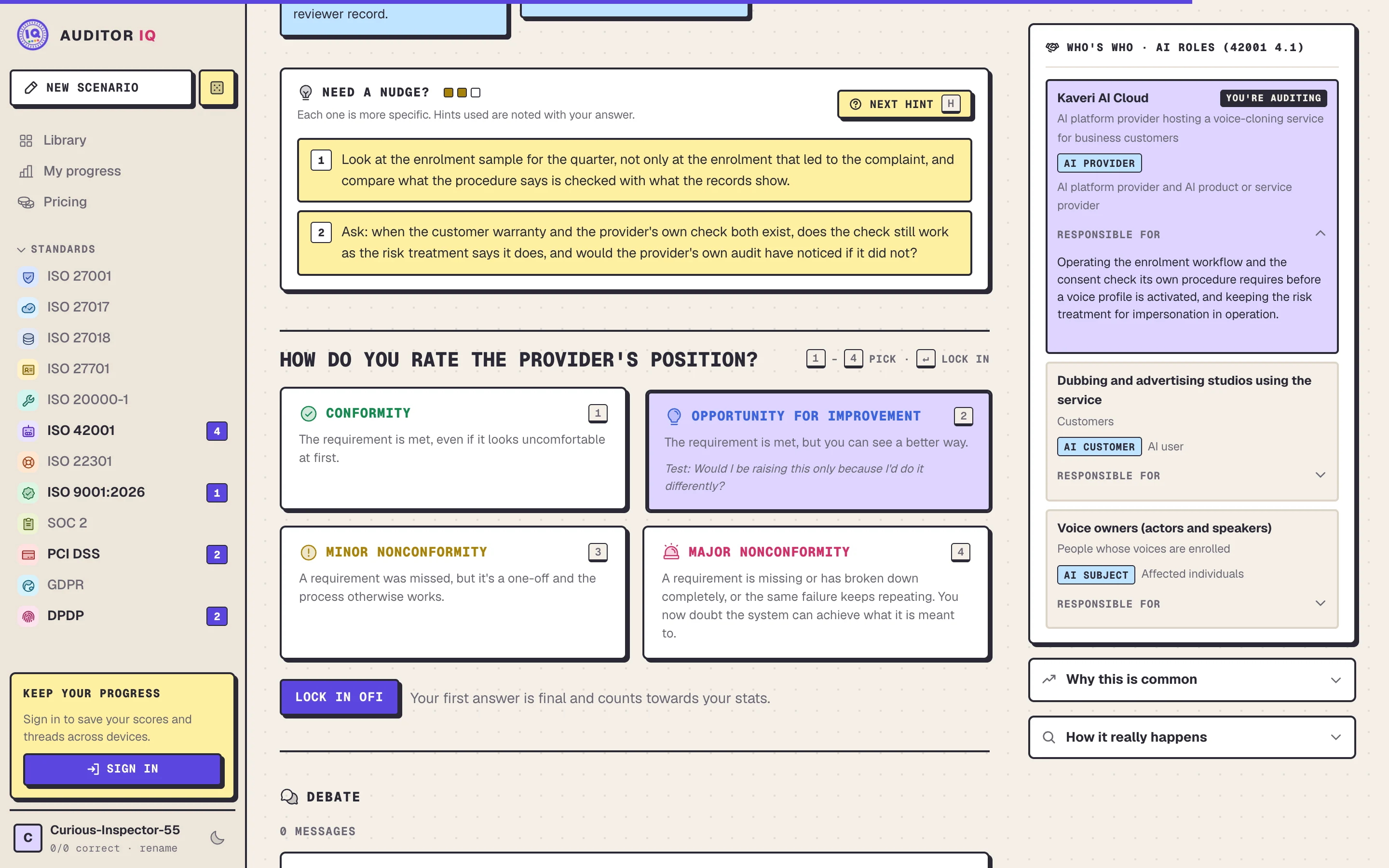
Pick the verdict an experienced auditor would give. Stuck? Unlock up to three hints, one at a time. Your first answer is final, and your score remembers how many hints you used.
- The framework's own verdicts, not generic multiple choice
- Hints nudge without handing over the answer
- Keyboard friendly: 1–4 to choose, Enter to submit
See why, then argue it out
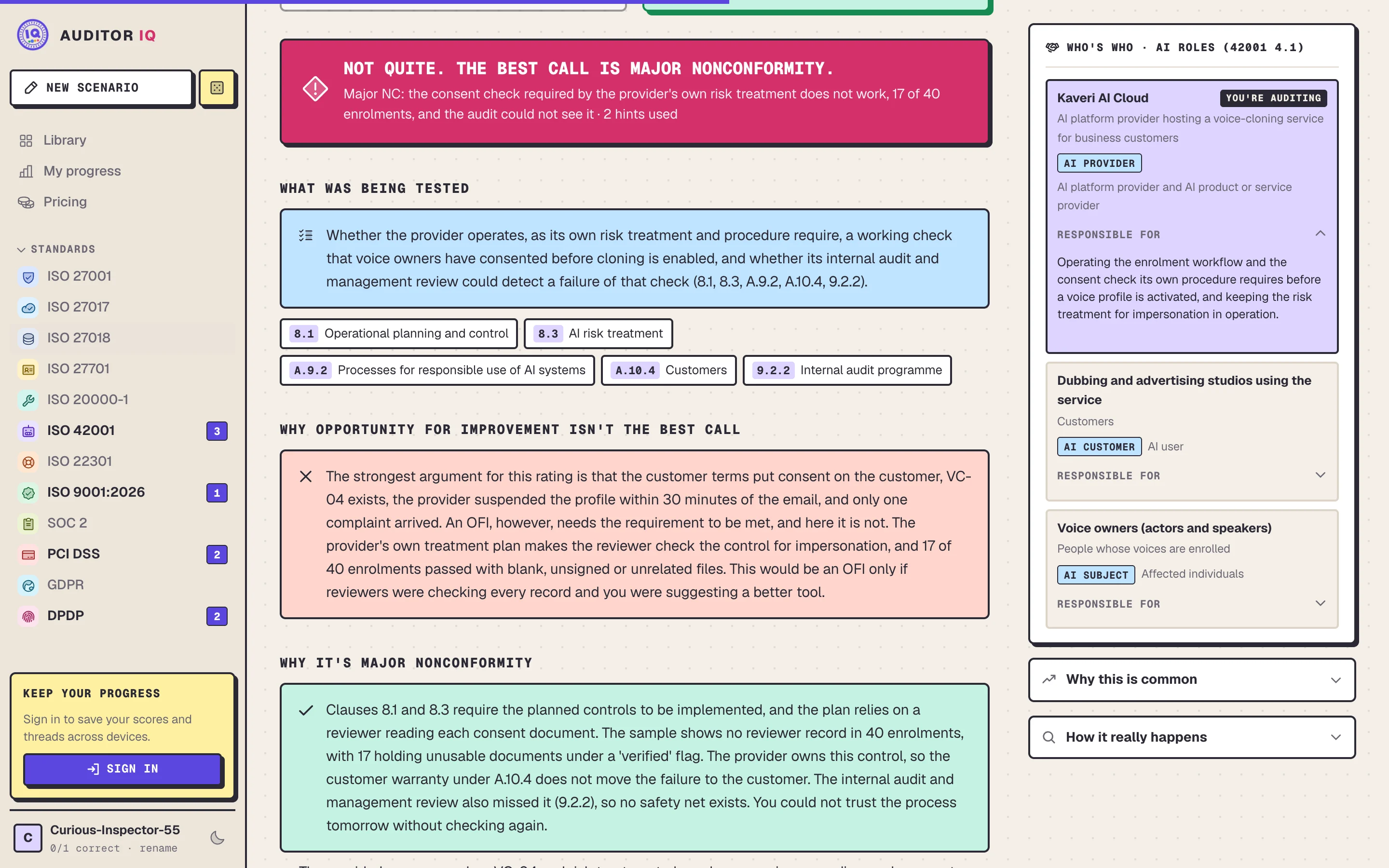
Find out what was really being tested, why the right verdict was right, why yours wasn't, and which trap was laid for you. Then see how everyone else voted and join the thread.
- Every option explained, not just the right one
- Clause references checked against the standard
- Agree, disagree or mark replies insightful
Why it works
Built the way auditors actually learn
Reading clause text doesn't teach you to grade a finding. Making calls on messy evidence, and finding out when you were wrong, does.
Every scenario has a trap
A deliberately tempting wrong answer, so you learn where Minor ends and Major begins, not just the definitions.
The answer key stays sealed
What's being tested and the clauses in play stay hidden until you commit. No peeking, no second tries.
Hints that nudge
Three progressive hints: two nudges, then the requirements in play. Use them when you're stuck, and see the cost in your stats.
Clause-checked
Every clause reference is checked against the standard's catalogue before a scenario is published. Made-up clauses get rejected.
Know your bias
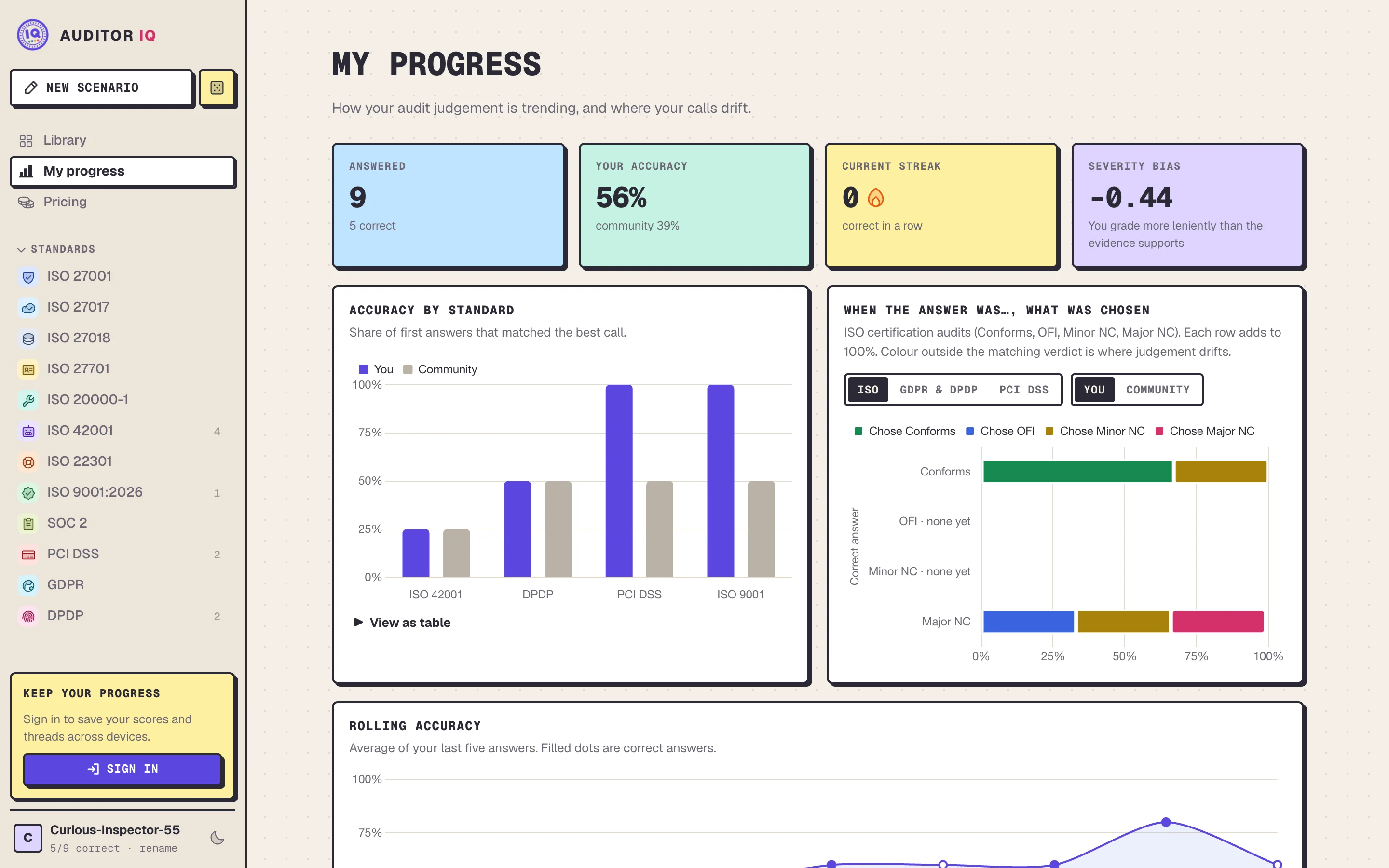
Do you over-call Major NCs? Your dashboard shows accuracy by standard, severity bias and the scenarios that caught you out.
Debate like a review panel
Threaded discussions open once you've answered, so everyone arguing has committed to a call first.
Frameworks
12 frameworks, each with its own verdicts
A GDPR scenario asks whether a penalty is likely. A SOC 2 scenario asks whether the opinion gets qualified. You practise the call that framework actually makes.
Your progress
See where your judgement drifts
Accuracy by standard, a matrix of right answer against your pick, rolling accuracy, and your severity bias: whether you tend to grade too harshly or too softly. Then go straight to the scenarios that beat you.
Pricing
Practise free every week. A pass opens everything.
Free, every week
₹0
- Today's scenario, the starter set and 3 library scenarios a week
- Full explanations and a hint on every scenario
- Threaded discussions and the community poll
- Accuracy by standard on your dashboard
New scenarios, on demand
₹35per scenario · 35 credits
- Top up from ₹100 by UPI or card
- Credits come back if a scenario fails to generate
- Or a pass from ₹299: the whole library, plus credits included
- Your first 2 new scenarios are free: 100 credits when you create an account
Questions
Before you make the call
Do I need an account?
Yes, a free one: sign in with Google or LinkedIn, no password. Your account keeps your scores, hints and threads across devices, and comes with 100 free credits, enough for 2 brand-new scenarios. Every week it also opens today's scenario, the starter set and 3 library scenarios, with full explanations and the debate.
What do credits pay for?
Brand-new scenarios written to your brief: 35 credits each, and 1 credit is ₹1. The shared library is free for 3 scenarios a week; a pass (from ₹299, one payment) opens all of it and includes credits.
What if a scenario fails to generate?
Your credits come straight back. They're only kept when a finished scenario is saved to the library.
Who is this for?
Internal and external auditors, lead-auditor candidates, GRC and compliance teams, and consultants who want to sharpen their judgement on realistic findings rather than memorise clause text.
Are the organisations real?
No. Companies and people are fictional, with deliberately playful names. The situations, records and controls are realistic, and job titles stay professional.
Is this official exam material?
No. Auditor IQ is an independent practice tool. It doesn't reproduce standards text and isn't affiliated with ISO, IEC, AICPA, the PCI Security Standards Council or any regulator.
Your next finding is waiting
Sign in with Google or LinkedIn and grade your first scenario in under five minutes.